CHALLENGE

Mexico has 4.9M independent workers who must issue CFDIs (government-mandated digital invoices) to work with corporate clients. The process requires RFC validation, SAT product codes from a catalog of 50,000+, tax regime classification, and PAC certification. Most entrepreneurs depend entirely on accountants, creating 1-2 week delays that directly impact cash flow.

The design question

What happens when you put an AI agent as the frontstage of a fiscal compliance service?

Why this is hard

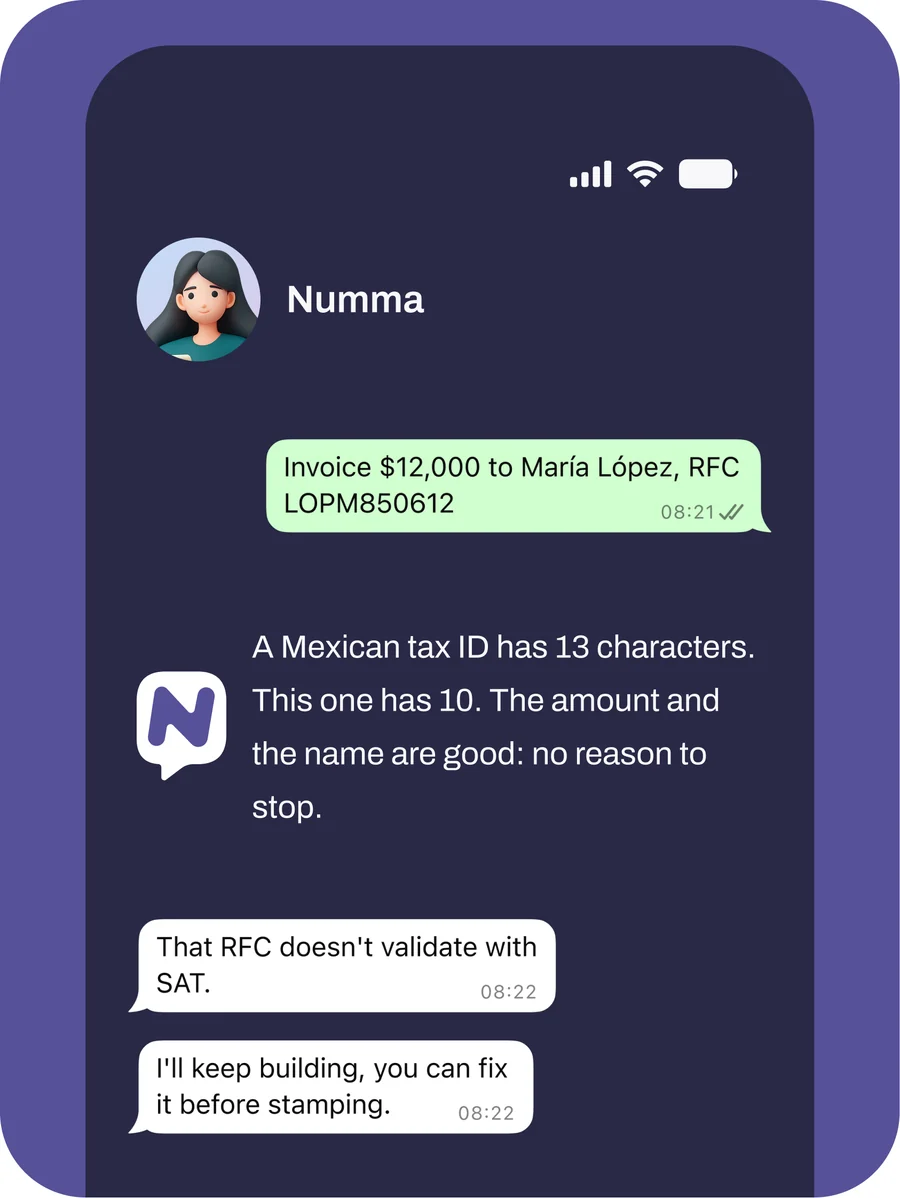
CFDIs have zero tolerance for error. A wrong SAT code or RFC makes the invoice legally invalid. But conversational AI is probabilistic: it interprets, suggests, and sometimes gets it wrong. Designing a service where AI handles tax-sensitive data means solving for trust in a domain where mistakes have legal consequences.

RESEARCH: 4 ENTREPRENEURS

We invested $8,914 MXN across 30 ads, generating ~90 leads. Zero converted from paid media. Our only paying customer came through personal referral. Zero conversions told us to stop advertising and start understanding.

Four ethnographic interviews revealed the core pattern: nobody wanted to replace their accountant. They wanted faster service, or an alternative when the accountant isn't available.

Business Consultant

$100K–$500K invoices. Accountant takes 1–2 weeks.

"Es tan difícil encontrar un buen contador. Es tan buena que tiene demasiado trabajo."

Research finding

Speed is the primary value. Wants faster service, not independence from accountant.

Design decision

Progressive Disclosure

One question at a time. Critical info first (who, how much), technical fields after.

Architect

10–15 invoices/month. Already uses Google AI to search SAT codes.

“Busco el código en Google y luego a ver cuál se parece”

Research finding

Struggles with 50,000+ SAT product codes. Already using AI workarounds.

Design decision

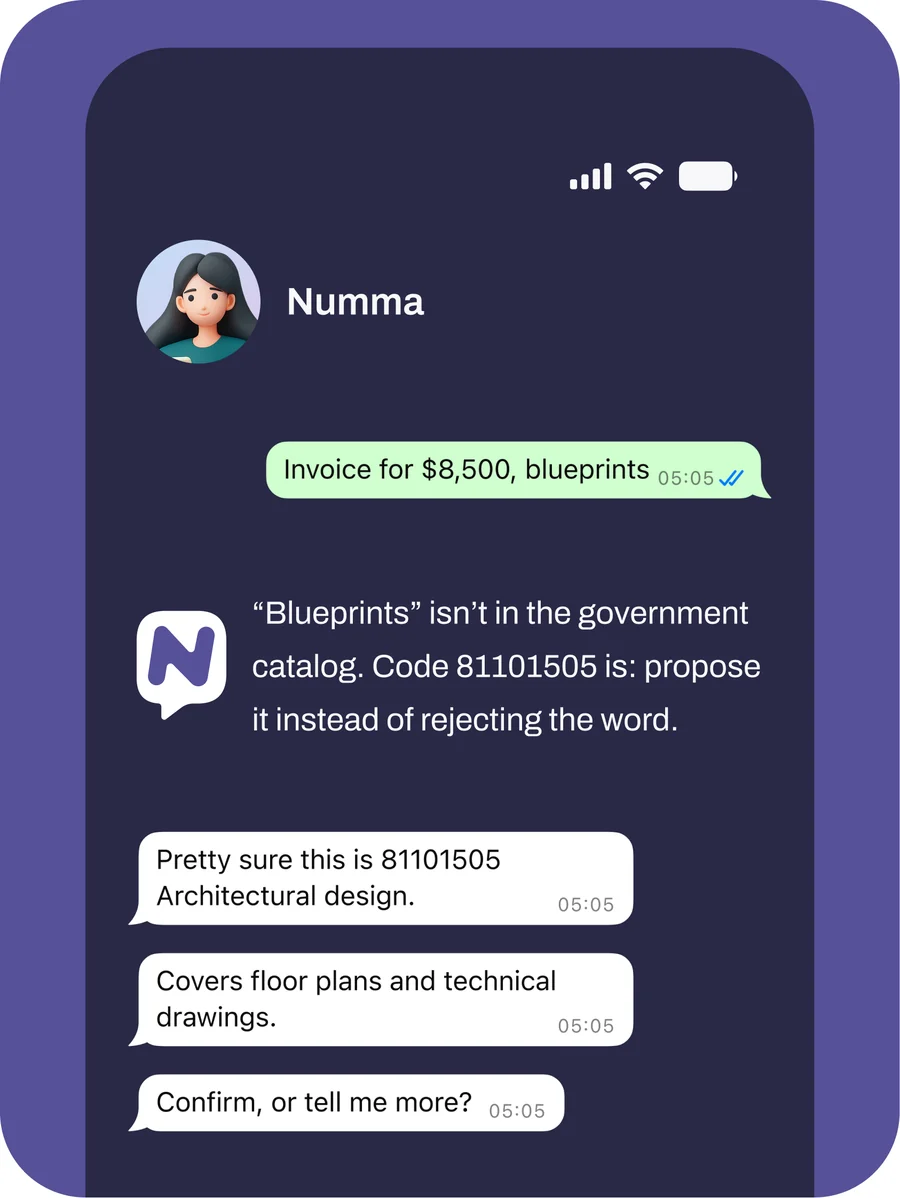
AI Code Suggestion

Natural language: code matching.

High confidence: auto-suggest with explanation. Low: show 2–3 options.

Mezcal Producer

40–50 invoices in 4 peak months, zero the rest.


“Necesito verla (factura) antes de enviarla”

Research finding

Needs visual preview before sending. Every invoice matters in a seasonal business.

Design decision

Confirmation before Action

Invoice preview is mandatory. AI never stamps without explicit user approval.

Freelance Photographer

Invoices for herself and colleagues. Charges commission.

"Quiero un asesor fiscal que me explique."

Research finding

Previous accountants had zero transparency. Would use AI only when accountant is unavailable.

Design decision

Education as Feature

AI explains WHY it chose each code and regime. "I suggest code 82111501 because your service is commercial design."

The pattern: Speed trumps autonomy

Nobody wanted to replace their accountant. They wanted faster service, or an alternative when the accountant isn't available. The AI complements an existing human relationship, not replaces it

THE AI SERVICE ARCHITECTURE

Why WhatsApp.

Mexican entrepreneurs spend 8+ hours daily on WhatsApp. It's where they negotiate, coordinate, and manage business. Building here meant zero downloads, zero passwords, zero learning curve.

The service blueprint maps what the user sees (AI frontstage) against what's invisible (human backstage). The gap between the two is the real design challenge.

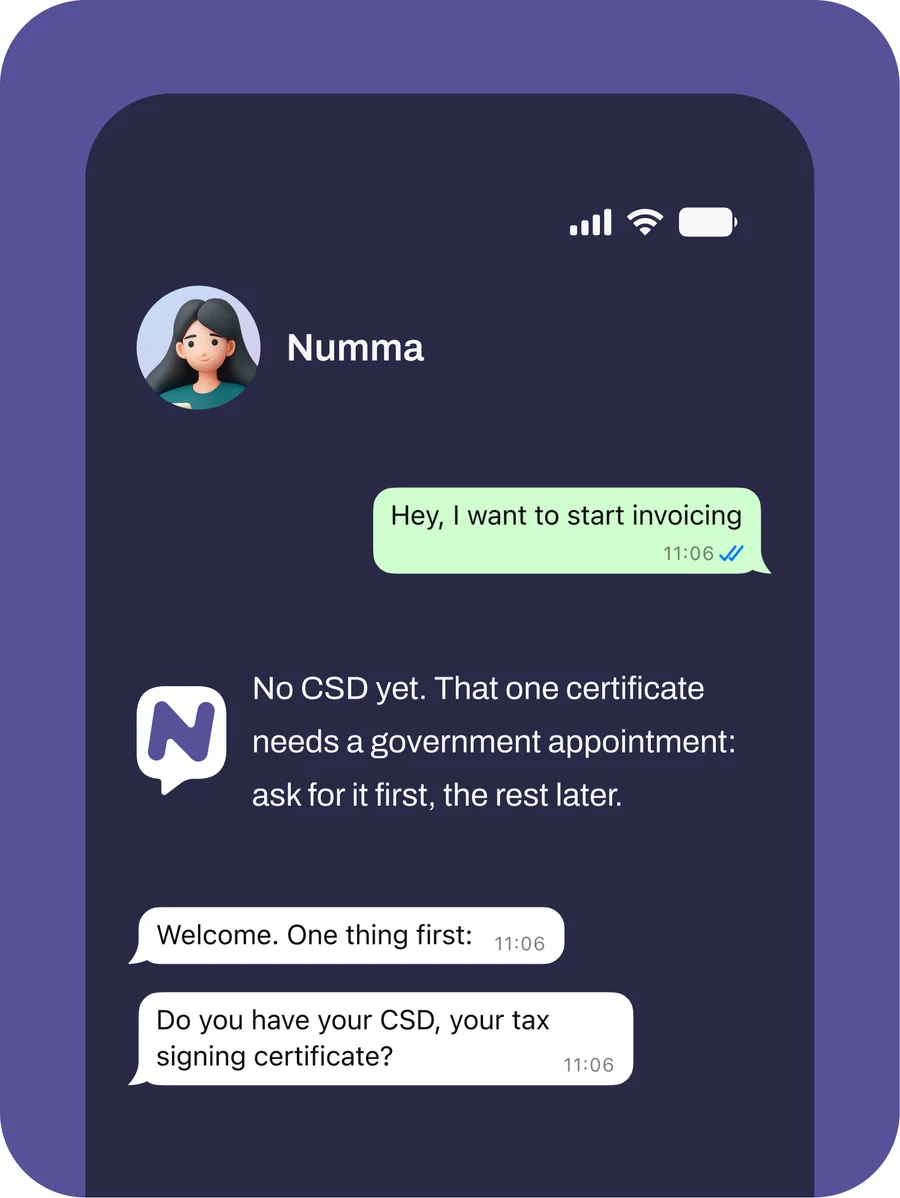
Building the service revealed a barrier invisible from the outside: almost no entrepreneur has the CSD (digital certificate) required for stamping. Getting one requires a valid e.firma, a Java app, the CertiSAT portal, and 24-72 hours activation. Our onboarding wasn't "send your RFC and start invoicing." It was "let us guide you through a multi-day government certification process."

CONVERSATIONAL DESIGN

The conversational flows follow principles from Elaine Anzaldo's (Meta) framework: progressive disclosure, fronting, cognitive load management, and drift recovery.

Progressive Disclosure. One question at a time, critical info first.

AI suggests from natural language instead of forcing selection from 50,000+ codes. Shows reasoning, not just result.

Confirmation before Action. Visual preview mandatory. AI never stamps without explicit approval.

Education as Feature. AI explains WHY, not just WHAT. Transparency builds trust.

Drift Handling. Parks off-script request, returns to flow. Nothing gets lost.

Human Backstage. AI knows its limits. Transparent handoff, no repetition.

WHAT I LEARNED

We assumed the wrong problem.

We designed for automation. The interviews revealed the real issue was service quality: accountants are saturated, opaque, and unreachable. Entrepreneurs want visibility into where their invoice is and immediacy, because in Mexico, a late invoice means a missed payment cycle. We weren't solving a technology problem. We were solving a service delivery problem.

Research before investment, always.

Four interviews reshaped the entire product direction. They cost almost nothing. The $8,914 in ads tested assumptions we hadn't validated. If I started today, I'd interview both segments first, understand the regulations deeply, and design around the CSD barrier instead of discovering it mid-build. Every PAC in Mexico hits the same onboarding wall. Solving that specific friction could be a competitive advantage, not just a blocker.

AI-first services need education-first positioning.

Users don't understand what an AI agent does, especially in a regulated domain. Positioning NUMMA as "AI invoicing" created confusion, not curiosity. The marketing should have led with what the service does for you, not how it works underneath.

Interested in how I design products?

CHALLENGE

Mexico has 4.9M independent workers who must issue CFDIs (government-mandated digital invoices) to work with corporate clients. The process requires RFC validation, SAT product codes from a catalog of 50,000+, tax regime classification, and PAC certification. Most entrepreneurs depend entirely on accountants, creating 1-2 week delays that directly impact cash flow.

The design question

What happens when you put an AI agent as the frontstage of a fiscal compliance service?

Why this is hard

CFDIs have zero tolerance for error. A wrong SAT code or RFC makes the invoice legally invalid. But conversational AI is probabilistic: it interprets, suggests, and sometimes gets it wrong. Designing a service where AI handles tax-sensitive data means solving for trust in a domain where mistakes have legal consequences.

RESEARCH: 4 ENTREPRENEURS

We invested $8,914 MXN across 30 ads, generating ~90 leads. Zero converted from paid media. Our only paying customer came through personal referral. Zero conversions told us to stop advertising and start understanding.

Four ethnographic interviews revealed the core pattern: nobody wanted to replace their accountant. They wanted faster service, or an alternative when the accountant isn't available.

Business Consultant

$100K–$500K invoices. Accountant takes 1–2 weeks.

"Es tan difícil encontrar un buen contador. Es tan buena que tiene demasiado trabajo."

Research finding

Speed is the primary value. Wants faster service, not independence from accountant.

Design decision

Progressive Disclosure

One question at a time. Critical info first (who, how much), technical fields after.

Architect

10–15 invoices/month. Already uses Google AI to search SAT codes.

“Busco el código en Google y luego a ver cuál se parece”

Research finding

Struggles with 50,000+ SAT product codes. Already using AI workarounds.

Design decision

AI Code Suggestion

Natural language: code matching.

High confidence: auto-suggest with explanation. Low: show 2–3 options.

Mezcal Producer

40–50 invoices in 4 peak months, zero the rest.


“Necesito verla (factura) antes de enviarla”

Research finding

Needs visual preview before sending. Every invoice matters in a seasonal business.

Design decision

Confirmation before Action

Invoice preview is mandatory. AI never stamps without explicit user approval.

Freelance Photographer

Invoices for herself and colleagues. Charges commission.

"Quiero un asesor fiscal que me explique."

Research finding

Previous accountants had zero transparency. Would use AI only when accountant is unavailable.

Design decision

Education as Feature

AI explains WHY it chose each code and regime. "I suggest code 82111501 because your service is commercial design."

The pattern: Speed trumps autonomy

Nobody wanted to replace their accountant. They wanted faster service, or an alternative when the accountant isn't available. The AI complements an existing human relationship, not replaces it

THE AI SERVICE ARCHITECTURE

Why WhatsApp.

Mexican entrepreneurs spend 8+ hours daily on WhatsApp. It's where they negotiate, coordinate, and manage business. Building here meant zero downloads, zero passwords, zero learning curve.

The service blueprint maps what the user sees (AI frontstage) against what's invisible (human backstage). The gap between the two is the real design challenge.

Building the service revealed a barrier invisible from the outside: almost no entrepreneur has the CSD (digital certificate) required for stamping. Getting one requires a valid e.firma, a Java app, the CertiSAT portal, and 24-72 hours activation. Our onboarding wasn't "send your RFC and start invoicing." It was "let us guide you through a multi-day government certification process."

CONVERSATIONAL DESIGN

The conversational flows follow principles from Elaine Anzaldo's (Meta) framework: progressive disclosure, fronting, cognitive load management, and drift recovery.

Progressive Disclosure. One question at a time, critical info first.

AI suggests from natural language instead of forcing selection from 50,000+ codes. Shows reasoning, not just result.

Confirmation before Action. Visual preview mandatory. AI never stamps without explicit approval.

Education as Feature. AI explains WHY, not just WHAT. Transparency builds trust.

Drift Handling. Parks off-script request, returns to flow. Nothing gets lost.

Human Backstage. AI knows its limits. Transparent handoff, no repetition.

WHAT I LEARNED

We assumed the wrong problem.

We designed for automation. The interviews revealed the real issue was service quality: accountants are saturated, opaque, and unreachable. Entrepreneurs want visibility into where their invoice is and immediacy, because in Mexico, a late invoice means a missed payment cycle. We weren't solving a technology problem. We were solving a service delivery problem.

Research before investment, always.

Four interviews reshaped the entire product direction. They cost almost nothing. The $8,914 in ads tested assumptions we hadn't validated. If I started today, I'd interview both segments first, understand the regulations deeply, and design around the CSD barrier instead of discovering it mid-build. Every PAC in Mexico hits the same onboarding wall. Solving that specific friction could be a competitive advantage, not just a blocker.

AI-first services need education-first positioning.

Users don't understand what an AI agent does, especially in a regulated domain. Positioning NUMMA as "AI invoicing" created confusion, not curiosity. The marketing should have led with what the service does for you, not how it works underneath.